Student Athletes and the College Essay
Signing ceremonies and state titles make headlines, not essays. Here is how to find the moment, the role and the honest sentence inside a season, drawing on the Rune's sports pages.
On November 8, 2017, thirteen Sacred Heart seniors took part in a fall signing ceremony and signed to play their sports in college: one golfer, four field hockey players, four swimmers and four basketball players. The Rune printed the full list with a college beside each name, and noted that between them the group had collected seven state titles in golf, swimming and field hockey. The athletic director said she was proud of them. The story ran 189 words.
Athletes in that position usually have to write about themselves at some point, for an admissions office or a scholarship committee, and the hard truth is that the signing story contains almost nothing an essay could use. A list of colleges is not a character. A count of state titles is not a story. The signing announcement is the résumé. The essay has to be the part the résumé cannot say.
This archive holds six years of sports coverage from a school that wins a great deal, and reading it with an essay in mind turns up a handful of patterns worth taking.
The roster line is already on the application
Admissions readers see the activities list before they see the essay. They already know you were a four-year varsity starter, a captain, a state champion. Spending the first paragraph of the essay repeating those facts is the most common mistake athletes make, and it is easy to see why: those facts took years to earn. But the reader has them in hand. What the reader does not have is a single afternoon from inside the sport.
Look at how the Rune handled the 2016 volleyball state championship, the program's first since 2003. The story gives the set scores and the awards, but the lines that stay with you are the ones about what a job feels like from the inside. The senior setter explained that her role was to make her hitters look good, which "requires being able to perform under pressure and having confidence in myself and my teammates." A senior defensive specialist repeated what the coaches had told the team about nerves before the final, and said the key had been staying confident in each other and in one goal. Those sentences describe a person. The 3-1 result describes an event.
Pick a moment, not a season
A season is too big for 650 words. A moment is about the right size. The sports pages are full of them because reporters are trained to find the turning point: the five minutes when a game changed, the one decision that explains the result.
In September 2017 the golf team played at Bowling Green Country Club, the site of the state championship, and lacked two of their top players, one because of an injury and one because of a disqualification for missing the tee time due to that Saturday's ACT. The write-up quotes the senior who led the team that day: she and a teammate "sat on the first tee and knew we had to step up." They won by three shots, the closest margin of the year, and the head coach talked about facing adversity and still coming out on top. That is an essay, or at least the spine of one. It has a problem, a decision, a specific place to stand, and a result that was not guaranteed. The state title that came a few weeks later is a single line of context by comparison.
When you hunt for your own moment, be suspicious of the final. Finals are crowded and everyone writes about them. The practice where something clicked, the bus ride after a loss, the first tee with two players missing: those are quieter and far more yours.
Write the role, not the stat line
The archive's profile of a swimmer who went on to Stanford opens with four fragments, a stack of titles that ends in "Stanford Commit." It is a good newspaper opening because it puts the credentials down fast. It would be a poor essay opening for the same reason. What the profile does well after that is let her talk about something ordinary, which is that she was most looking forward to the group of teammates and coaches at the new school, and that she had not settled on a major. Readers lean toward a person who is still deciding.
The best opening lines for a personal statement work the same way: they put the reader somewhere specific and hold the credentials back until they are needed. There is a useful collection of personal statement opening lines that shows how often the strongest first sentence is the smallest one. For an athlete, the smallest sentence is usually about a role. What were you for, on that team? The setter who makes the hitters look good has answered that question. So has the defender a rivalry-game story credits with anchoring the defense all night.
Losses count, and so do endings
Coverage of winning teams can make it look as though the only sports story worth telling ends with a trophy. The archive says otherwise. In October 2016 the field hockey team lost a state semifinal 1-0 on a sudden-death overtime goal to Assumption, which had won four of the five meetings between the two teams, three of those wins by a single goal. The story names the ten departing seniors, 2015 state champions, then lets one of them say that the sport taught her about leadership and that the relationships and memories "are so much more than just winning and losing."
That is a reflective sentence, and reflection is what scholarship committees are actually asking for when they ask about challenges. The danger is stopping at the sentence. A reflective essay needs the overtime goal, the bus, the locker room, and then the thought; the thought on its own is a greeting card. A guide to writing reflective essays lays out the sequence, experience first and meaning second, and athletes who have lost a big game in front of their parents have more raw material for it than they think.
If you will not play in college
Most high school athletes stop at graduation, and that is its own essay. A 2016 cross country story about the regional meet, which the school also marked as Senior Day, includes a senior runner who called it bittersweet to be finishing and said she did not plan to compete in college but would run with friends and do her own workouts. The story gives that decision room alongside the team's second-place finish and its qualification for state. There is no signing day for choosing to stop, and the choice is at least as revealing as a signature. An athlete who can explain what the sport was for, once the scoreboard is gone, has found the center of her essay.
The same holds for the athlete who played all four years without a varsity letter, or who switched sports, or who was injured and spent a season keeping the book. Those stories are rarer on the sports pages, which is a reason to tell them, not a reason to hide them.
Before you send it
Read the draft once as your coach would and once as a stranger would. The coach will catch the places where you took credit the team earned. The stranger will catch the places where you assumed everyone knows what a setter does or why a missed tee time matters. Then check for the three things the sports pages model on nearly every page: a specific day, a named role, and at least one sentence you would not be comfortable reading aloud at a banquet. If all three are there, the essay is doing what the signing story could not.
Quick questions
Should a student athlete write the college essay about sports at all?
Only if the essay says something the activities list cannot. The list already records the sport, the years, the captaincy and the titles. If the essay offers a specific moment, a role on the team, or a decision the reader would not otherwise know about, sports is a fine subject.
Is it a mistake to write about a loss or about quitting a sport?
No. Coaches and admissions readers both know that most seasons end without a trophy and most athletes stop playing after high school. A loss or an ending, described honestly and followed by what you did next, often reveals more than a championship does.
How is a scholarship essay different from a college application essay?
Scholarship prompts are usually narrower and often ask directly about leadership, challenges or service. The same material works, but match the moment you choose to the prompt, keep the sport in service of the question, and expect a shorter word limit than the main application allows.
Stories discussed here
13 Valkyries sign to play at collegiate level
Thirteen Sacred Heart seniors signed on November 8 to play golf, field hockey, swimming and basketball at colleges from Kentucky to South Carolina.
SHAlleyball Takes State
Sacred Heart beat Henry Clay 3-1 to win the 2016 KHSAA volleyball state championship, the school's second title and first since 2003.
Golfers up to par once again
Sacred Heart golf beat Russell County by three shots at Bowling Green Country Club despite missing two top players.
Forde Builds Legacy One Stroke at a Time
Senior swimmer Brooke Forde, a Stanford commit and Olympic Team Trials qualifier, discusses her best events and what she looks forward to at Stanford.
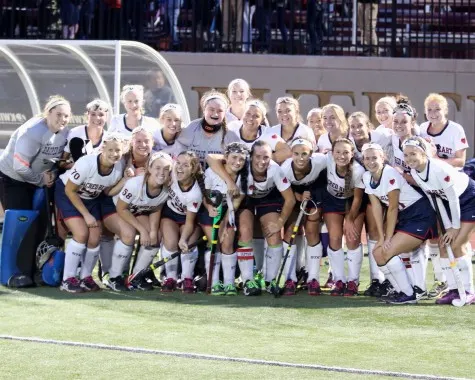
Field Hockey Falls Short in State Semi-Finals
Sacred Heart field hockey lost 1-0 to Assumption on a sudden death overtime goal in the state semifinal, ending a 21-6 season.
Valkyries Vie for Victory
Sacred Heart cross country finished second at Regionals on October 29, qualifying for State, while Kathleen Simms won the race.
More from the Reading Room
All piecesWhat a School Newspaper Teaches About Writing
Student reporters learn to put the point first, let sources speak, and cut what does not earn its place. Six articles from the archive show how, and how the same habits carry into essays.
From Service Trip to Application Essay
The sentence every service essay reaches for is the one to cut. The Rune's coverage of mission trips, gift drives and a dance marathon shows what to keep instead.
Team Trips and College Visits
Tournaments in Las Vegas and Ohio, an art trip to New York, spring break in Belize and Thailand, and the campus visits seniors arrange themselves. What the archive shows about budgets, schedules and paperwork.
Winter and Spring Break Abroad
The Rune's winter break lists stay in Kentucky; its spring break stories go to Thailand, Belize and Nicaragua. What a student brings home from either depends on noticing, and on a notebook.