From Service Trip to Application Essay
The sentence every service essay reaches for is the one to cut. The Rune's coverage of mission trips, gift drives and a dance marathon shows what to keep instead.
You came back from the trip on a Sunday, slept most of Monday, and by Wednesday someone had asked you to write about it. The sentence that arrived first was some version of this: the experience made me more grateful for what I have. You wrote it down. It is true. It is also the one sentence every admissions reader has seen a thousand times, and it will be the first thing a good editor asks you to cut.
The Rune covered service at Sacred Heart for six years: spring break builds in Belize and Nicaragua, a gift drive for children and teens in Kermit, West Virginia, a Habitat for Humanity club, a dance marathon for pediatric cancer research. Student reporters wrote those stories under deadline with no thought for college essays, which is exactly why they are useful here. They show what service work looks like on the page before anyone has decided what it means.
The sentence everyone writes
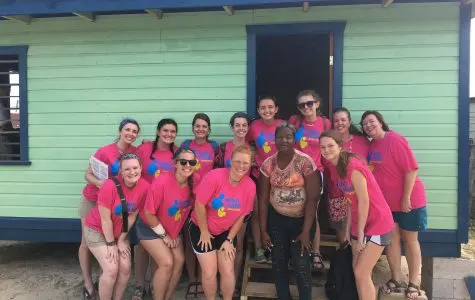
Start with the 2017 story on the Belize mission trip. Ten students spent a week with Hand in Hand Ministries building a house for an elderly woman, visited preschool and kindergarten classes, and came home. Near the end a senior tells the reporter the trip made her more appreciative of what she has and more thankful for her life. That is the sentence. The reporter did not cut it, and should not have, because in a news story a quote is evidence of what people said.
But look at what sits above it in the same article. A teacher chaperone describes local women who worked on the house alongside the students, some who had already received a house from the ministry and some still on the waiting list for one, and calls the build "a community event." She describes the ministry's method as helping one person at a time. Those are details you cannot get from a brochure. A woman still waiting for her own house, spending her week building someone else's: that is where an essay starts, and the gratitude sentence is where it would otherwise end.
Borrow the reporter's habits
The most instructive piece in the archive is a first-person account of a 2014 spring break trip to Nicaragua, also with Hand in Hand. The writer spent a week helping build the back half of a concrete house for a family whose front half had been put up by an earlier group. The account closes the way you would expect, with paragraphs about how the trip changed her outlook. The paragraphs before it are much better, and they are better because they are specific.
Two helpers on the site, a little older than the students, got along with them despite the language barrier. One raced them on the support beams and then said he was "all finished." The other threw water and found the visitors' reactions amusing. The homeowner choked up while thanking the group on the last day. The second half of each day was split between the ministry's education program, where children aged nine to eleven played baseball and went swimming with the visitors, and exploring the city of Managua. One evening the group climbed a mountain beside a volcano and sat and watched the sun go down. None of those sentences claims the trip was life-changing. Together they prove it.
This is the oldest narrative advice there is, and it is also what reporters are trained to do by their second week on a paper. Get the name of the game they played. Get what the man said when he won the race. Get the time of day. If you want the technique laid out in order, a guide to writing a narrative essay covers scene, sequence and the moment of change, and a service trip supplies all three without any invention.
Numbers first, then faces
Gift drives generate numbers, and numbers are not nothing. The Community Awareness Committee's 2016 Appalachian Gift Drive collected 2,743 gifts and more than $1,600 for the children and teens of Kermit, West Virginia, after the deadline was pushed back a week to reach a campus goal of 1,700. The wrap-up story has those figures and one more thing: when committee members delivered the gifts to Kermit, they decorated pumpkins with the children to look like turkeys.
A number tells a committee what the group accomplished. A pumpkin dressed as a turkey tells them you were there. Use both, in that order, and spend most of your words on the second.
The kickoff story from the same drive is worth reading for a different reason. The reporters quoted one of the two Ursuline sisters who started the drive on how it began. She remembered a box of toys that were not very nice, and people asking whether they could find something for their children, and realizing the sisters did not yet know anyone there who could supply toys, so Sr. Janet thought of calling Sacred Heart. She also said people had remarked to her that without the drive they would not have any Christmas for their kids. If your service has a history, find the person who remembers it. The origin of a thing is nearly always more interesting than its current size.
The work before the event
Most service essays describe the day of the event. Most of the work happens before it, and that work is often where the writer's real contribution lives. The Rune's preview of the first ValkyrieBEAT dance marathon in March 2017 is largely about the months before: a club that had been working since August, committees for each part of a large event, percentage nights at two restaurants, more than $2,300 raised in the first few months, after-school practices so the whole school could learn a six-minute line dance, and Valentine's cards made for pediatric cancer patients and delivered to the children.
One junior told the paper that the best part of delivering the cards was meeting the children and their parents, and seeing that "something so easy to make like a card" could make them so happy. The preview ran the day before the marathon, before anyone knew the total. The second marathon a year later raised $14,843.03 and the paper printed the figure, but the card is the better paragraph. It describes a specific delivery, a small object, and a reaction from the children.
What you are allowed to admit
Service essays often fail by being too clean. The archive's report on the 2016 Service Fair, where upperclassmen pitched agencies to freshmen and sophomores with poster boards, has a line from a freshman who planned to volunteer at a local center and said it would take her out of her comfort zone. That is an admission, and a small one, but it is the kind of sentence readers trust. The same story quotes the vice president of the Habitat for Humanity club, who had been working with the club since her own freshman year, on the plainest reward there is: seeing the finished product after the work.
You are allowed to say you were nervous. You are allowed to say you went for the hours at first, that the service honor roll was part of the appeal, that the first day was boring. The Service Fair story mentions the honor roll and the hour requirements without embarrassment, because for a sophomore those are real. An essay that admits the ordinary motive and then shows what replaced it is more persuasive than one that claims to have arrived fully formed.
One sentence, rewritten
Take the gratitude sentence from the start of this piece and run it through what the archive has shown. Before: the trip made me more grateful for what I have. After, invented here to show the shape, using the kind of detail the Belize reporter found: on the third day a woman who was still on the waiting list for her own house showed me how to brace a wall, and I spent the rest of the week trying to work as hard as she did. The second version is longer. It is also the only one of the two that could have been written by you and no one else.
Before you submit, run the draft against a short essay checklist: a specific day, a named place, one person who is not you, one number, one admission, and a last paragraph that does not begin with what you learned. The reporters in this archive hit most of those marks on deadline, between classes, without being asked. You have more time than they did.
Quick questions
Is it a problem if my service essay sounds like everyone else's?
It is the most common problem. Mission trips and gift drives produce similar conclusions, so the way to stand out is not a different conclusion but different evidence: a named place, a specific afternoon, one person who is not you, and a detail you could not have predicted.
Should I include numbers like hours served or dollars raised?
Yes, briefly. A total tells the reader the scale of the work and that you can be precise. Then move on. Spend most of the essay on a single scene, because a number says what the group did and a scene shows what you did.
What if my service work was ordinary, with no trip and no big event?
Ordinary service is easier to write well, because it has repetition and small changes over time. Weekly visits, a long gift-drive sort, or a Habitat build produce the same raw material as a trip abroad: a routine, a person, and a moment when the routine shifted.
Stories discussed here
Building Houses and Bonds on Belize Mission Trip
Ten Sacred Heart students spent spring break in Belize with Hand in Hand Ministries, building a home for an elderly local woman named Judith.
SHA Students Dedicate Spring Break to Helping Others
Twelve Sacred Heart girls spent spring break helping build a concrete house in Nicaragua and spending time with local children.
That’s A Wrap On The CAC Gift Drive
The Community Awareness Committee's gift drive raised 2,743 gifts and over $1,600 for children and teens in Kermit, West Virginia.
CAC Gift Drive Kicks Off Holiday Season
The CAC Gift Drive, started by two Ursuline sisters, collects gifts for impoverished families in Kermit, West Virginia, and runs Oct. 31 to Nov. 7.
ValkyrieBEAT: Dancing For a Cure
ValkyrieBEAT, Sacred Heart's first dance marathon, aimed to raise $10,000 for pediatric cancer research at the University of Louisville.
Service Fair is Success
At Sacred Heart's annual Service Fair, upperclassmen presented agencies like Habitat for Humanity to freshmen and sophomores planning their service hours.
More from the Reading Room
All piecesWhat a School Newspaper Teaches About Writing
Student reporters learn to put the point first, let sources speak, and cut what does not earn its place. Six articles from the archive show how, and how the same habits carry into essays.
Student Athletes and the College Essay
Signing ceremonies and state titles make headlines, not essays. Here is how to find the moment, the role and the honest sentence inside a season, drawing on the Rune's sports pages.
Team Trips and College Visits
Tournaments in Las Vegas and Ohio, an art trip to New York, spring break in Belize and Thailand, and the campus visits seniors arrange themselves. What the archive shows about budgets, schedules and paperwork.
Winter and Spring Break Abroad
The Rune's winter break lists stay in Kentucky; its spring break stories go to Thailand, Belize and Nicaragua. What a student brings home from either depends on noticing, and on a notebook.